



Your implant settled in years ago and you stopped thinking about it. Then it aches on hard foods, or the gum beside it feels tender, and you start wondering why now, after all this time.
Dental implant pain years later is worth taking seriously, because an implant that has integrated should not hurt. A tooth implant replaces missing teeth with a titanium post set into the jawbone, and that post has no nerve. Any discomfort comes from the gum, the bone or the crown on top, and each has a different answer. If something has changed around an old dental implant, it is worth having assessed.
Quick Overview
- An implant has no nerve, so implant pain comes from the soft tissue, the surrounding bone or the crown.
- Peri-implantitis is inflammation around the implant with bone loss, and it is one of the main reasons for late dental implant failure.
- Poor oral hygiene, smoking and a history of gum disease all raise the risk.
- Caught early, it is usually manageable, so an implant that feels loose or sore should be assessed, not watched.
The sections below cover why late implant pain happens, what peri-implantitis is, what else causes it, and the treatment options.
Why does implant pain appear years after placement?
Pain can occur years after implant surgery, and it signals that something around the implant has changed, not that the original implant placement was wrong. Osseointegration means the bone has grown around the implant and holds it firmly, and once that has happened, the implant site should be comfortable.
Two things sit around every implant: soft tissue and bone. A gum infection limited to the soft tissue is reversible with cleaning. Inflammation that has reached the surrounding bone is a different matter, because bone that is lost does not return on its own.
You cannot tell which of the two you have by looking, so persistent discomfort is worth checking even when nothing looks wrong.
What is peri-implantitis?
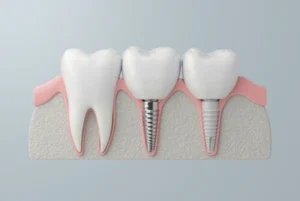 Peri-implantitis is a bacterial infection of the tissues around an implant, with progressive loss of the jawbone that supports it. It is one of the main drivers of dental implant problems in the years after placement.
Peri-implant health is defined by no bleeding, no deepening pockets and no bone loss around the implant. Bleeding when you brush is often the first sign that has changed. Swelling, tenderness and gum recession can follow, and by the time an implant feels loose, considerable bone has usually gone.
A history of gum disease is the risk factor that matters most. Patients with previously treated periodontitis develop peri-implantitis at a markedly higher rate, and lose more bone around their implants over the following decade. Poor oral hygiene and smoking compound it, and diabetes is a recognised risk factor too. Some autoimmune diseases may contribute in rare cases.
What else can cause dental implant pain?
Not every ache is an infection. Mechanical complications cause similar symptoms in many patients, and those are usually simpler to fix.
Teeth grinding loads an implant in a way it was not designed for. An implant has no ligament to cushion pressure, so grinding transfers force straight into the bone, and soreness on biting can follow. A night guard is the usual answer.
A loose crown or abutment screw is another common culprit. The implant is stable but the tooth on top moves slightly, which irritates the gum and feels like the implant itself is failing. Food trapping beside the implant causes similar tenderness, and so can a problem in an adjacent natural tooth.
What are the treatment options?
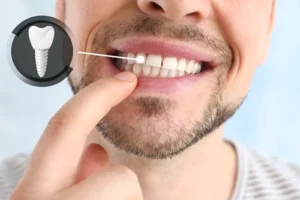 Treatment depends on how far the inflammation has travelled. When it is confined to the soft tissue, most patients settle with professional cleaning around the implant and improved oral hygiene at home.
Once bone loss has started, more is needed. That may mean cleaning the implant surface beneath the gum, antibiotics, or surgical access to decontaminate the area. Bone grafting is sometimes used to rebuild what has been lost. Where too much bone has gone, removing the implant and planning a replacement is the more predictable option.
Whichever treatment is needed, the routine afterwards is the same as for natural teeth. Brush twice a day, clean between the implant and your other teeth with floss or interdental brushes, and keep regular check-ups. Swelling or inflammation of the gums or bone should be checked by your dentist, not monitored at home.
Talk to Harris Dental Boutique about your implant
An implant that has started to hurt needs an X-ray, because the bone level around it cannot be judged by looking at the gum. At Harris Dental Boutique, we examine the implant site, compare the bone against earlier images, and check whether the crown or screw has loosened before anything is decided. To arrange an appointment, please call us on 07 4158 5813.
Frequently Asked Questions
Can the body reject a dental implant?
Not in the way a transplanted organ is rejected. Titanium is well tolerated in the mouth. When patients describe implant rejection, the implant has usually failed to integrate with the bone in the first place, or bone has been lost around it later through infection.
Is it normal for the gum around an implant to bleed when I brush?
No. Gums around a healthy implant should not bleed with ordinary brushing. Bleeding is often the earliest sign of inflammation, and at that stage it is usually reversible, so book an appointment at that point instead of waiting for pain.
Does an implant that feels loose always have to come out?
Not always. If the movement is in the crown or the screw holding it, that can be tightened or replaced with the implant left in place. If the implant itself moves, the bone holding it has gone, and removal is generally necessary.
Can a failed dental implant be replaced?
Often, yes. The site needs to heal first, and bone grafting may be required to rebuild enough bone to hold a new implant. Whether a second attempt suits you depends on why the first one failed.
Any surgical or invasive procedure carries risks. Before proceeding, you should seek a second opinion from an appropriately qualified health practitioner.
References
https://www.teeth.org.au/dental-implants
https://www.betterhealth.vic.gov.au/health/conditionsandtreatments/teeth-and-mouth-care