



Losing a tooth, or several, tends to lead to the same question: what is the right way to fill the gap? For most of us, the answer comes down to a dental implant vs dentures, two well-established ways to replace missing teeth that suit different mouths, budgets and priorities.
They arrive at the same destination by very different routes. This article unpacks how each one works, where they part ways, and the questions worth asking yourself, so that talking through dental implant treatment or dentures feels a lot clearer.
Quick Overview
- A dental implant is a titanium post set into the jawbone that acts as an artificial tooth root, holding a fixed replacement tooth on top.
- Dentures are custom-made removable teeth: a partial set that bridges a few gaps, or a full set that replaces a whole jaw.
- Implants carry a higher upfront cost and involve minor surgery, while dentures cost less to begin with and avoid surgery altogether.
- Implants help keep the jawbone healthy, whereas dentures sit on the gums and are simpler to start with, so the better fit depends on your mouth, health and budget.
Here is how the two stack up, from the way they are fitted to how they feel years down the track.
The essential difference between implants and dentures
At its core, the difference is straightforward: an implant is anchored inside the jaw, while a denture rests on the gums and lifts out. That one distinction shapes nearly everything else, from what you pay to how your jaw fares over the years.
Both exist to solve the same problem. The usual causes of tooth loss are decay, gum disease and injury, and whatever created the gap, implants and dentures both work to help you chew, speak and smile comfortably again. Neither approach is new or experimental; both have helped patients eat and speak comfortably for decades.
How a dental implant works
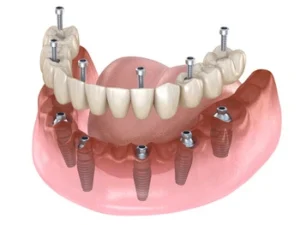 A dental implant is a small titanium post that a dentist places into the jawbone during a minor procedure, taking over the role a natural tooth root once played. After it heals, it carries a crown, a dental bridge, or even a denture on top.
The stability comes from a process called osseointegration, in which the bone knits tightly around the post over a few months, effectively making the implant part of your jaw. Because it lives in the bone rather than on the gum, an implant does not lean on the neighbouring teeth and can restore a single tooth, several teeth, or serve as an anchor for a larger set. Acting as artificial tooth roots, these titanium posts can carry anything from one crown to a full row of replacement teeth, and the result looks and works much like your natural teeth.
Fitting one does require surgery and enough healthy bone; where bone density falls short, bone grafting may be arranged at the implant site first. In return, implants keep the jaw stimulated, which supports bone preservation, and dental implants offer a fixed solution that, with proper care and good oral hygiene, is built to last.
How dentures work
Dentures work in the opposite way. Instead of going into the bone, they are removable appliances that rest over the gums, custom-built to match your mouth. Partial dentures fill in a few missing teeth and clip onto the remaining natural teeth, resting partly on those adjacent teeth for support, while full dentures replace every tooth across the upper or lower jaw. Traditional dentures have been used for generations and remain a practical way to replace multiple teeth at once.
Most are built from a gum-coloured acrylic resin base with false teeth set into it, and the way a denture is fitted and worn has improved considerably, so modern dentures carry a more natural appearance than the sets of decades past. They hold their position through suction, small clasps on the surrounding teeth, or a little adhesive, and lift out for cleaning each day. Since fitting them does not involve an operation, dentures are a non-invasive solution that many patients can have fairly quickly. One thing to keep in mind is that the gums and jaw beneath a denture change shape over time, so dentures typically need relining or remaking to keep fitting well.
The differences that matter most
When weighing a dental implant vs dentures, a few practical points usually settle it. Three tend to matter most.
Cost now versus cost over time
Dentures typically cost less at the outset than dental implants. With no surgery and fewer appointments, the lower upfront cost is a real draw if budget is your primary concern, and dentures generally suit those wanting to spend less to begin with. Dental implant costs sit higher at the outset, because the treatment involves surgery, components and several visits. The gap narrows with time, though: dentures are relined or replaced periodically, while an implant is made to endure, so the long-term difference is smaller than that first quote suggests.
What happens to your jaw and face
Here, implants have the edge. A natural tooth root keeps the jawbone working, and an implant does the same, helping slow the jawbone loss that usually follows tooth loss. A denture only presses on the surface, so the bone underneath can slowly shrink, and over many years that bone loss can soften your facial structure. The potential effect on the jawbone is one factor to consider when comparing implants with removable options.
Living with each option
Day to day, an implant functions much like the tooth it replaced: it stays fixed in place and is cleaned with an ordinary brush and floss. A denture needs a little more routine, as it is taken out for cleaning and some wearers notice slight movement, particularly with a lower-jaw set. Chewing tends to be more efficient with implants, though a well-made denture handles most everyday meals comfortably. Whichever you choose, looking after your mouth day to day protects your long-term oral health, along with regular dental check-ups and care of any other teeth you still have.
Can you combine the two? Implant-supported dentures
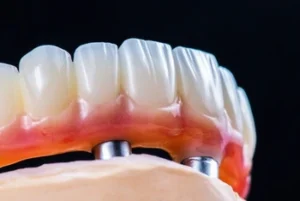 There is also a middle option. An implant-supported denture is a full denture that clips onto a small number of implants, so it stays securely in place instead of relying on suction or adhesive.
This suits someone replacing a whole arch who wants more stability than a standard denture, but not a separate implant for every tooth. A few implants support the entire set, which makes it more affordable than placing individual implants across the jaw. As with any implant, it depends on having enough healthy bone, so it is one of the tooth replacement options your dentist can assess for you.
Working out what suits you
There is no single option in the dental implant vs dentures decision; the right choice depends on your circumstances. The number of teeth being replaced, the condition of your jawbone, your general health, any medical conditions, and your budget all play a part.
As a general guide, implants tend to suit those who want a fixed, low-maintenance result and have the bone and health to support one, while dentures suit those replacing multiple missing teeth, wanting to avoid surgery, or working to a tighter budget. Each treatment option has its place. A professional assessment, where a dentist examines your mouth and explains the benefits and limitations of each, is a reliable way to decide which option fits your needs.
 Discuss your tooth replacement options with Harris Dental Boutique
 Discuss your tooth replacement options with Harris Dental Boutique
If you are weighing up how to replace one missing tooth or several, the most useful next step is a proper look at your mouth and an honest conversation about the choices. At Harris Dental Boutique, we assess your teeth, gums and jaw, explain what each path would mean for you, and lay out the costs clearly.
To talk it through, please call us on 07 4158 5813.
Frequently Asked Questions
Can I wear a denture while my dental implants heal?
Yes, and it is common. Since implants take a few months to fuse with the bone before the final teeth are attached, many patients wear a temporary denture in the meantime so they are not left with a visible gap. Your dentist will talk through which temporary option may be appropriate for your situation.
Will dentures or implants change the way I speak?
There can be a brief settling-in with either, but it rarely lasts. A new denture might make certain sounds feel different for a short while as your tongue and cheeks adapt, and practising by reading aloud helps. Implants, being fixed like your own teeth, seldom affect speech once they have healed.
How long does it take to get used to wearing dentures?
Adjusting usually takes a few weeks. In the early days, a new set can feel bulky, and eating takes some practice, so starting with softer foods and smaller mouthfuls makes it easier. If a denture keeps rubbing or feels loose once that adjustment period has passed, have it checked so it can be tweaked.
Are dental implants or dentures a better choice for older adults?
Age on its own is rarely the deciding factor; general health and available bone matter far more. Many older adults do very well with implants, while others prefer dentures to sidestep surgery or to keep costs down. The right call rests on your health and how you want to live day to day, not your age alone.
What happens if I lose more teeth after choosing implants or dentures?
Both can be adapted, in different ways. A partial denture can sometimes be remade or extended to cover new gaps, whereas implants are placed one site at a time, so a fresh gap may need its own plan. Flagging any loose or troublesome teeth to your dentist early makes it easier to plan ahead.
Note: Any surgical or invasive procedure carries risks. Before proceeding, you should seek a second opinion from an appropriately qualified health practitioner.
References
https://www.teeth.org.au/dental-implants
https://www.betterhealth.vic.gov.au/health/conditionsandtreatments/dental-treatment