



Two teeth on one implant means a single dental implant carries a crown with a second tooth attached to its side, replacing two adjacent teeth. For slightly larger gaps, two implants can support a three-unit bridge. Which suits you depends on where the gap is, your bone and your gums, and we assess each when planning dental implant treatment.
Quick Overview
- One implant can carry two teeth when one tooth sits on the implant, and the other is attached to its side.
- Evidence supports this design for front teeth, while a trial in back teeth reported more technical complications.
- Too little bone or severe gum disease can make implant treatment unsuitable.
- Where one implant can’t carry two teeth, two implants can be used instead.
Below, we explain when each option applies.
Can One Implant Carry Two Teeth?
One implant can hold two artificial teeth as an implant-supported bridge. This is known as a cantilever bridge, because the extra tooth is supported from one end only.
The implant is a titanium screw that acts as an artificial tooth root in the jawbone, so this single fixture takes the chewing forces for both teeth. Single tooth implants, by contrast, replace one missing tooth per implant.
When Can One Implant Carry Two Teeth?
For front teeth, the evidence for this design is encouraging. A review found similar implant survival over time whether two missing teeth were replaced with one implant or two, across central incisors, lateral incisors, canines and first premolars.
When Can’t One Implant Carry Two Teeth?
Back teeth are less straightforward. In a trial of short implants followed for seven and a half years, one implant with a cantilever gave implant survival similar to two implants, but with more technical complications. In that trial, failures also occurred earlier with one implant, suggesting two implants share the load more favourably.
You may not be a good candidate for implant treatment if there is too little bone at the implant site or you have severe gum disease.
Two Implants and a Three-Unit Bridge
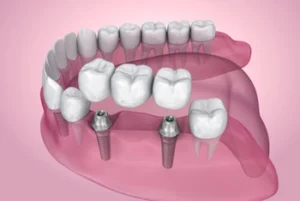 Where one implant can’t carry two teeth, two implants can be used instead. For a three-tooth gap, two individual implants can support a three-unit dental bridge, with an implant at each end and a replacement tooth held between them. Unlike individual porcelain crowns, the three teeth are joined into one fixed bridge.
Neither option relies on crowning adjacent healthy teeth, because the implants hold the bridge. How many implants you need depends on the gap, your bone and your dental health, which your dentist covers in your treatment plan. Longer gaps with several teeth missing, or a full arch, need a different plan with multiple implants.
What Does the Treatment Process Involve?
The dental implant procedure starts with X-rays so your dentist can measure the bone and plan the implant position. The implant is then placed in a surgical procedure under local anaesthetic. Over about three months, the bone grows around the implant. Once healing is complete, the replacement teeth are attached.
Caring for Two Teeth on One Implant
Dental implants cannot decay, but inflammation of the gums and bone loss can develop around them. Left untreated, this inflammation can loosen implants and lead to implant failure. Daily oral hygiene means brushing twice a day and cleaning between the implant and surrounding teeth with floss, interdental brushes or a water flosser. Your dentist will show you how to clean an implant bridge, as the method differs from cleaning a single implant. Regular dental checkups and professional cleans help you care for the implant and support your oral health.
Talk to Harris Dental Boutique About Replacing Two Teeth
 Whether one implant can carry two teeth can only be confirmed during an examination. At Harris Dental Boutique, we use 3D imaging and digital scanning alongside a full examination to see the shape of your mouth and gums before explaining your options. Our dentists then talk you through each tooth replacement option at our dental clinic and what it involves. To discuss replacing two teeth, please call us on 07 4158 5813.
Frequently Asked Questions
How much does it cost to have two teeth on one implant?
The cost of replacing two or more teeth depends on your treatment plan, including whether additional procedures are needed first. An accurate figure comes from an assessment and a written quote. Private health insurance may cover part of the cost.
Will I experience discomfort after implant surgery?
You may have bruising, swelling of the gums or face, bleeding from the gums and some pain after the procedure. Your dentist may suggest pain medication and soft foods while the area heals.
What if I do not have enough bone for an implant?
Bone grafting adds bone, or a bone-like material, to the jaw so an implant can be placed. The graft can be your own bone or processed bone.
Will the replacement teeth match my natural teeth?
Whether you are replacing one tooth or multiple teeth, implant crowns are made to match your neighbouring teeth. They are made in a laboratory while the implant heals. Our clinic has an on-site lab.
Which health conditions can affect dental implant treatment?
Osteoporosis, diabetes, cancer, bleeding disorders and smoking can affect the jawbone or raise the chance of infection and other complications. Age-related changes in bone density can also affect how stable an implant becomes. Some bone-strengthening medicines are linked to rare jaw bone problems after implant surgery, so tell your dentist your full medical history.
Any surgical or invasive procedure carries risks. Before proceeding, you should seek a second opinion from an appropriately qualified health practitioner.
References
https://www.healthdirect.gov.au/dental-implant
https://www.betterhealth.vic.gov.au/health/conditionsandtreatments/dental-treatment