



Losing all the teeth in an upper or lower arch can feel overwhelming. Eating becomes difficult. Speaking may change. Smiling can feel uncomfortable. Over time, the structure of the face may even begin to shift.
Full-arch dental implants offer a structured, carefully planned way to replace teeth across an entire dental arch. Rather than managing loose or removable dentures, many patients choose a fixed solution that restores function and stability.
This guide explores full arch dental implants in depth, explaining how they work, who they suit, and what to expect from consultation to final teeth.
What Are Full Arch Dental Implants and How Do They Work?
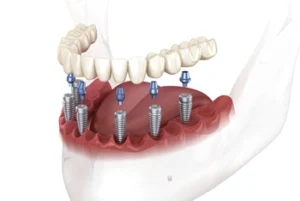
Full-arch dental implants replace all the teeth in an upper or lower jaw using a small number of strategically placed dental implants. These implants function as replacement tooth roots and provide a stable foundation for a fixed prosthesis, commonly referred to as a full arch bridge.
Instead of replacing each tooth individually with traditional implants, arch dental implants use fewer implants to support a complete set of prosthetic teeth. In many cases, four implants are used to anchor a full arch restoration. You may hear this described as 4 dental implants supporting an entire arch.
The result is a stable, fixed structure that mimics the appearance and function of natural teeth.
Why Do People Choose Full Arch Implants?
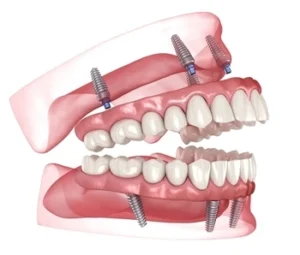 Missing teeth can create more than aesthetic concerns. Over time, bone in the upper or lower jaw may shrink. The bite may shift. Chewing certain foods becomes difficult. Oral health can decline, particularly if gum disease or infection was the original cause of tooth loss.
Many patients who struggle with traditional dentures seek a more secure alternative. Removable dentures can move while eating or speaking, and they do not stimulate the jawbone as effectively as dental implants.
Full arch implants provide stability and support while helping preserve bone in the dental arch.
A Permanent Solution for Replacing Teeth
For most patients, full arch implant treatment offers a long-term option for replacing teeth. Because the implants are embedded in bone, they provide a strong foundation for the final teeth. The full arch rehabilitation process is carefully planned to ensure functional bite alignment and aesthetic harmony.
How Full Arch Dental Implant Surgery Is Planned: It Begins With an Initial Consultation
Every full arch dental journey begins with an initial consultation. During this appointment, dental professionals assess oral health, bone levels, gum condition, and medical history.
Advanced technology, such as digital imaging and 3D scans, assists in treatment planning. These tools help determine whether sufficient bone exists for arch implants or whether bone grafting may be required.
Treatment planning is essential. Each full arch case is unique. The number and position of implants, the shape of the prosthetic teeth, and the design of the fixed prosthesis are all tailored to the individual.
The Implant Procedure Step by Step
Dental implant surgery is an invasive procedure that involves inserting titanium posts into the upper or lower jaw to act as artificial tooth roots. While any invasive procedure carries risks, careful assessment and planning by an appropriately qualified health practitioner helps minimise complications.
In many full arch cases, four implants are placed at specific angles to maximise contact with available bone. This technique allows strong support without requiring as many traditional implants as single tooth replacements.
The implant procedure typically involves:
- Placement of implants into the jawbone
- Temporary prosthetic teeth in some cases
- Healing period to allow integration between the implant and the bone
Osseointegration is the natural healing process in which the implant bonds directly with the surrounding bone tissue. This phase is essential for ensuring long-term strength and stability.
Bone Grafting and Preparation for Arch Implant Treatment
Not every patient has enough bone volume for immediate implant placement. If bone has been lost due to gum disease or long-term tooth absence, bone grafting may be recommended.
Bone grafting involves adding bone material to strengthen the area before dental implant surgery. Although this extends the timeline, it improves long-term outcomes.
Most patients are suitable candidates for full arch implant treatment, but each case must be assessed individually.
Comparing Full Arch Implants to Traditional Dentures: Stability Versus Removability
 Traditional dentures rest on the gums. They can shift while eating, which may cause sore spots. Because they do not integrate with bone, gradual bone loss continues.
In contrast, arch dental implants anchor directly into bone. A full arch bridge attached to implants does not move. This stability allows a stronger chewing force and clearer speech.
Removable dentures may still be appropriate in certain situations, but many patients prefer a fixed solution when clinically suitable.
How Full Arch Rehabilitation Restores Function
Full arch restoration aims to replicate the function of natural teeth as closely as possible. Once healed, most patients can eat a wide variety of foods with comfort.
Lower teeth replacement, in particular, can be transformative. The lower jaw often experiences greater denture instability. Arch implants in the lower jaw significantly improve chewing confidence.
With a properly designed fixed prosthesis, speech clarity typically improves compared to removable dentures.
What Happens After Implant Surgery? Healing and Transition to Final Teeth
Following dental implant surgery, a healing phase begins. During this time, implants integrate with bone. In some cases, temporary teeth are worn while healing occurs.
After sufficient integration, the final teeth are designed and fitted. These prosthetic teeth are designed with precision to complement facial features, support proper bite alignment, and reflect individual aesthetic goals.
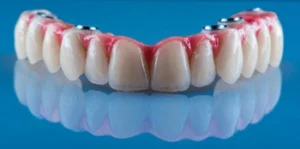
The final result is a full arch bridge secured to implants. Unlike removable dentures, this solution does not require nightly removal.
Long-Term Care and Oral Health Maintenance
While implants do not develop decay in the same way as natural teeth, maintaining good oral health is still essential for long-term success. The surrounding gum tissue must stay healthy to support arch implants.
Regular reviews with dental professionals are important. Professional cleaning helps prevent inflammation around implants.
Daily hygiene typically includes brushing, specialised flossing tools, and possibly water irrigation devices to clean beneath the fixed prosthesis.
Full arch dental restorations can last many years with consistent care.
Who Is a Suitable Candidate? Factors That Influence Eligibility
Many patients who have lost all the teeth in an upper or lower arch are potential candidates. However, suitability depends on several factors:
- Overall health
- Bone density
- Smoking habits
- History of gum disease
- Commitment to maintenance
An appropriately qualified health practitioner will determine whether full arch implant treatment is appropriate after thorough assessment.
Brisbane patients and individuals from other regions often travel for consultations, but careful follow-up is always important.
Risks and Considerations: A Balanced Understanding Matters
It is important to acknowledge that dental implant surgery is a surgical or invasive procedure. Any invasive procedure carries risks such as infection, swelling, nerve disturbance, or implant failure.
However, with modern advanced technology and careful treatment planning, complications are relatively uncommon in healthy individuals.
Open discussion during the initial consultation allows patients to understand potential risks, recovery expectations, and long-term responsibilities.
The Role of Advanced Technology in Modern Implant Dentistry
Advanced technology plays a significant role in successful full arch outcomes. Digital scanning, guided surgical templates, and computer-assisted design enhance accuracy.
Precise placement of four implants or more ensures even load distribution across the dental arch. This reduces stress on individual implants and improves the longevity of the full arch bridge.
Technology also assists in designing prosthetic teeth that look natural and align harmoniously with facial features.
What Makes Full Arch Implants Feel Different?
The difference between removable dentures and a fixed prosthesis is noticeable from the first day. Many patients describe improved comfort and stability.
Because arch implants are secured within the upper or lower jaw, there is no movement during chewing. Confidence when eating in social settings often improves.
Full arch rehabilitation does not simply replace missing teeth. It restores structural support to the face and enhances overall function.
How Many Implants Are Needed? Four Implants or More?
In many cases, four implants are sufficient to support a full arch restoration. This configuration can provide strong stability while minimising surgical complexity.
Some cases may require additional implants depending on bone quality and bite forces. Traditional implants for each individual tooth are rarely necessary in full arch cases.
The decision is always based on careful clinical evaluation.
The Emotional and Functional Impact of Replacing All the Teeth
Tooth loss affects nutrition, speech, and self-perception. Lower teeth or upper or lower teeth that are unstable can limit food choices and reduce dietary variety.
Replacing teeth with a structured full-arch implant treatment often improves chewing efficiency. This can contribute to better nutrition and overall well-being.
Many patients report that full arch dental treatment restores not just their smile but also daily comfort and routine confidence.
How Long Does Full Arch Implant Treatment Take?
 The overall timeline depends on the bone condition and whether bone grafting is required.
For patients with adequate bone, implants may be placed and provisional teeth fitted within a relatively short timeframe. Healing then occurs over several months before the final teeth are secured.
If bone grafting is needed, additional healing time is required before implant surgery.
Clear communication during treatment planning ensures realistic expectations.
Frequently Asked Questions About Full Arch Dental Implants
Are Full Arch Implants Painful?
The implant procedure is performed under appropriate anaesthesia. Some discomfort after surgery is normal, but it is typically manageable with prescribed guidance.
Can Full Arch Implants Fail?
Although success rates are high, implant failure can occur. Risk factors include uncontrolled gum disease, smoking, and poor oral hygiene.
Do They Feel Like Natural Teeth?
While prosthetic teeth are not biological teeth, a properly designed fixed prosthesis often feels stable and natural during daily use.
Final Thoughts on Full Arch Dental Implants
Full arch dental implants represent a structured, modern approach to replacing all the teeth in an upper or lower arch. Through careful treatment planning, advanced technology, and precise dental implant surgery, many patients achieve stable and functional outcomes.
This form of arch dental rehabilitation is not simply about aesthetics. It supports oral health, restores chewing ability, and strengthens the structural integrity of the upper or lower jaw.
As with any surgical or invasive procedure, informed discussion with dental professionals is essential. A personalised assessment by an appropriately qualified health practitioner helps determine suitability and guide expectations.
For most patients who qualify, full arch implants offer a long-term and stable solution. With proper care, maintenance, and regular review, full arch restoration can provide comfort, durability, and reliable function for many years.
If you are considering full arch dental implants and would like personalised guidance, contact Harris Dental Boutique on 07 4158 5813 to arrange a comprehensive consultation and discuss whether this treatment is right for you.
Note: Any surgical or invasive procedure carries risks. Before proceeding, you should seek a second opinion from an appropriately qualified health practitioner.
References
NHS. (n.d.). Dentures (false teeth). NHS. Retrieved from https://www.nhs.uk/tests-and-treatments/dentures/
Colgate. (2023, January 9). Signs of a failed dental implant. Colgate Oral Health Center. Retrieved from https://www.colgate.com/en-us/oral-health/implants/signs-of-a-failed-dental-implant
Cleveland Clinic. (2025, March 25). Local anesthesia: What it is, uses, side effects & types. Cleveland Clinic. Retrieved from https://my.clevelandclinic.org/health/procedures/local-anesthesia
FDI World Dental Federation. (n.d.). Good oral health through life. FDI World Dental Federation. Retrieved from https://www.fdiworlddental.org/good-oral-health-through-life